

 English
 中文简体
中文简体 عربى
عربىWhen looking at aquaculture aeration equipment, it is easy to put Impeller Aerators and Float Type Aerators into two separate groups. In practice, the difference is not that simple. An impeller describes the way water is moved, while a float type design describes how the equipment stays on the water.
This distinction becomes useful when comparing equipment for fish ponds, shrimp ponds, seawater farming, and other aquaculture applications. A floating machine can have an impeller inside its working system, so the two terms can describe different parts of the same piece of equipment.
Rather than choosing an aerator by its name alone, it makes more sense to look at how it moves water, where it operates, how the pond is laid out, and what conditions the machine will face.
Impeller and Float Type Describe Different Things
An impeller aerator gets its name from the rotating component that moves the water. The impeller creates water movement and surface disturbance, which increases contact between water and air. Depending on the design, it can also help move water through the pond.
A float type aerator is named for its support structure. Floats keep the equipment at the water surface instead of fixing it to the bottom of the pond or placing it on a permanent platform.
So, the two terms answer different questions.
- Impeller: How does the equipment move water?
- Float type: How is the equipment supported?
Once this is understood, comparing the two becomes much easier. They are not necessarily two competing designs.
How Does an Impeller Aerator Move Water?
The working principle of an impeller aerator is fairly straightforward. A motor turns the impeller, and the rotating movement pushes and disturbs the surrounding water.
As water moves, the surface becomes more active and more water comes into contact with air. At the same time, the movement created by the impeller can help carry water away from the immediate operating area.
The actual water pattern depends on the shape and arrangement of the working components. Some designs create stronger surface agitation, while others place more emphasis on moving water outward and encouraging circulation.
This matters because an aerator is not working in an empty tank. A real aquaculture pond may contain fish, shrimp, feed residues, suspended material, vegetation, and areas with different water movement. Pond depth and shape also affect the way water travels after leaving the aerator.
Why Water Circulation Matters
Adding oxygen to water is only part of the job. That oxygenated water also needs to reach the areas where it is needed.
If water movement is limited, oxygen conditions may vary from one part of a pond to another. Mechanical circulation can help move water around the operating area and reduce sections where movement is weak.
For this reason, the location of an impeller aerator should be considered together with the pond layout. Simply increasing the number of machines does not automatically create a suitable circulation pattern.
What Makes a Float Type Aerator Different?
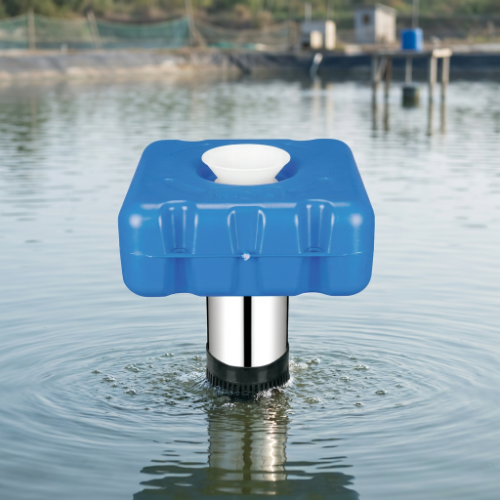
A float type aerator is built to operate on the water surface. The floating structure supports the motor and other working parts while allowing the equipment to rise and fall with the water level.
This is particularly relevant to outdoor ponds because water levels can change during normal operation. Rain, evaporation, water exchange, pumping, and farm management can all affect the height of the water.
With a fixed installation, a change in water level also changes the relationship between the equipment and the water surface. A floating unit moves with the surface instead.
A floating system may include several parts working together:
- Floating support components
- Motor and mechanical drive
- Water intake section
- Water outlet or discharge section
- Rotating or pumping components
- Electrical connection and protection components
- Mooring or positioning equipment
The exact arrangement varies according to the intended application and the design of the machine.
Are Impeller Aerators and Float Type Aerators Opposites?
No. This is probably the most important point when comparing them.
An aerator can be both an impeller aerator and a float type aerator.
For example, a floating machine may use a motor-driven impeller to create water movement. In that case, "impeller" tells you something about its working mechanism, while "float type" tells you how the machine is installed.
This is why product descriptions can sometimes appear confusing when different manufacturers use different terminology. The better approach is to look beyond the category name and check the actual construction.
Impeller Aerator vs Float Type Aerator at a Glance
| Point of Comparison | Impeller Aerator | Float Type Aerator |
|---|---|---|
| What the name describes | The water-moving mechanism | The equipment support method |
| Main feature | Rotating impeller | Floating structure |
| Water movement | Created by impeller rotation | Depends on the internal working mechanism |
| Installation | May be fixed or floating | Designed for surface operation |
| Changing water level | Depends on installation | Unit follows the water surface |
| Position adjustment | Depends on the specific design | Can be moved when the installation allows it |
| Key selection concern | Water movement and circulation | Flotation, positioning, anchoring, and water conditions |
When Can a Floating Design Be Useful?
A floating arrangement can make sense when the water surface is not always at the same level.
Consider a pond that receives rainwater during one period and loses water through evaporation or water exchange later. A floating aerator remains on the surface as the level changes. The operator does not have to treat the equipment as a fixed structure at one particular depth.
Another consideration is positioning. Some ponds require aeration in different areas at different times. A floating machine may be easier to reposition than equipment that has been permanently installed.
There is also the question of access. Depending on the pond and mooring arrangement, a floating unit can sometimes be brought closer to a convenient working area for inspection or maintenance.
That does not mean every floating installation is simple. The unit still needs appropriate anchoring, safe electrical connections, suitable cable routing, and regular checks.
What Should Be Considered in Seawater?
Seawater changes the equipment selection process because saltwater can create additional corrosion concerns.
Components exposed to seawater need materials and construction suitable for that environment. This includes not only the main body of the machine but also fasteners, exposed mechanical parts, electrical connection areas, and other components that may come into contact with water or salty air.
For a seawater aquaculture operation, a floating oxygenator can bring together several useful functions. The floating structure keeps the machine at the surface, while the mechanical system moves water and increases air-water contact.
A seawater floating oxygenator is therefore not simply a conventional aerator placed on a float. The whole system needs to be considered as a unit, including its water intake, circulation path, materials, flotation arrangement, and positioning method.
How Should Buyers Compare Different Aerators?
Start with the pond rather than the catalog.
A machine that works in one aquaculture setup may not have the same role in another. The water type, pond shape, depth, stocking situation, and operating routine all affect the selection.
Look at the Water Environment
Freshwater and seawater place different demands on equipment.
If the machine will operate in seawater, ask about the materials used for exposed components and how the equipment is intended to handle the working environment.
Look at the Pond Layout
Water movement is affected by the shape of the pond.
A long and narrow pond has a different circulation pattern from a broad pond. Obstacles, pond banks, water inlets, and other equipment can also change how water moves.
Think About Changing Water Levels
If water levels move regularly, a floating configuration can be worth considering. The equipment follows the surface rather than remaining at one fixed height.
Check Maintenance Access
Mechanical equipment needs inspection regardless of where it is installed.
It is worth checking how the motor, rotating parts, water intake, electrical connections, and other components can be reached. A design that fits the daily maintenance routine can make operation more convenient.
Consider the Desired Circulation
Do not look at oxygenation separately from water movement.
The position and working direction of an aerator influence where the water travels. In a larger pond, circulation planning can be just as important as the choice of the machine itself.
What About a Floating Oxygenator for Seawater Aquaculture?
For seawater applications, a floating oxygenator can be considered when the operation needs surface-based water movement and oxygenation.
The Floating Oxygenator Sea Water Type supplied by Taizhou Yuansheng Aquacul Ture Machinery Co., Ltd. is designed around a floating structure for seawater aquaculture applications. Its working system combines water movement with oxygenation while the floating arrangement keeps the equipment on the water surface.
The design is also intended to work with changing water levels. Instead of depending on a fixed installation height, the floating structure follows the water surface.
For operators working with seawater ponds, this type of arrangement can be considered where mobility, surface operation, and corrosion-related material considerations are part of the equipment requirements.
The actual suitability still depends on the individual application. Before ordering, buyers should discuss the water environment, pond conditions, installation method, operating needs, and maintenance arrangements with the equipment supplier.
Common Mistakes When Comparing Aerators
One mistake is assuming that "floating" tells you everything about the machine. It does not. Two floating aerators can use different mechanical systems and produce different water movement.
Another mistake is treating motor power as the only factor that matters. Power consumption is one part of the equipment selection, but the water flow, mechanical arrangement, installation position, and pond conditions also need attention.
Seawater applications bring another common issue: overlooking corrosion. A machine may appear suitable from its basic structure, but the materials used on exposed parts can make a difference during long-term operation.
Positioning is sometimes overlooked as well. Even a suitable aerator may not circulate water effectively if it is installed without considering the pond's shape and existing water movement.
A Simple Way to Remember the Difference
If you only remember one thing, make it this:
An impeller aerator is named for how it moves water.
A float type aerator is named for how it stays on the water.
These descriptions can exist together in the same machine. That is why a floating aquaculture aerator may also be described as an impeller aerator if an impeller is used as its main water-moving component.
The difference between Impeller Aerators and Float Type Aerators becomes much clearer once the terminology is separated.
An impeller refers to the rotating mechanism used to create water movement. A float type design refers to the structure that supports the equipment at the water surface. One describes the working principle, while the other describes the installation method.
For aquaculture equipment selection, the useful questions are therefore practical ones. What type of water will the machine operate in? How does the pond change throughout the year? What kind of circulation is needed? How will the equipment be positioned? Can the working parts be inspected easily? Are the materials suitable for the water environment?
For seawater farming, these questions are especially relevant. A floating oxygenator can provide a combination of surface positioning, water movement, and oxygenation, while its suitability depends on the conditions of the particular aquaculture operation.
Taizhou Yuansheng Aquacul Ture Machinery Co., Ltd. supplies aquaculture machinery for different applications, including floating oxygenation equipment and mechanical aerators. Its seawater floating oxygenator is developed for applications where water movement and oxygenation are needed in a floating configuration.